
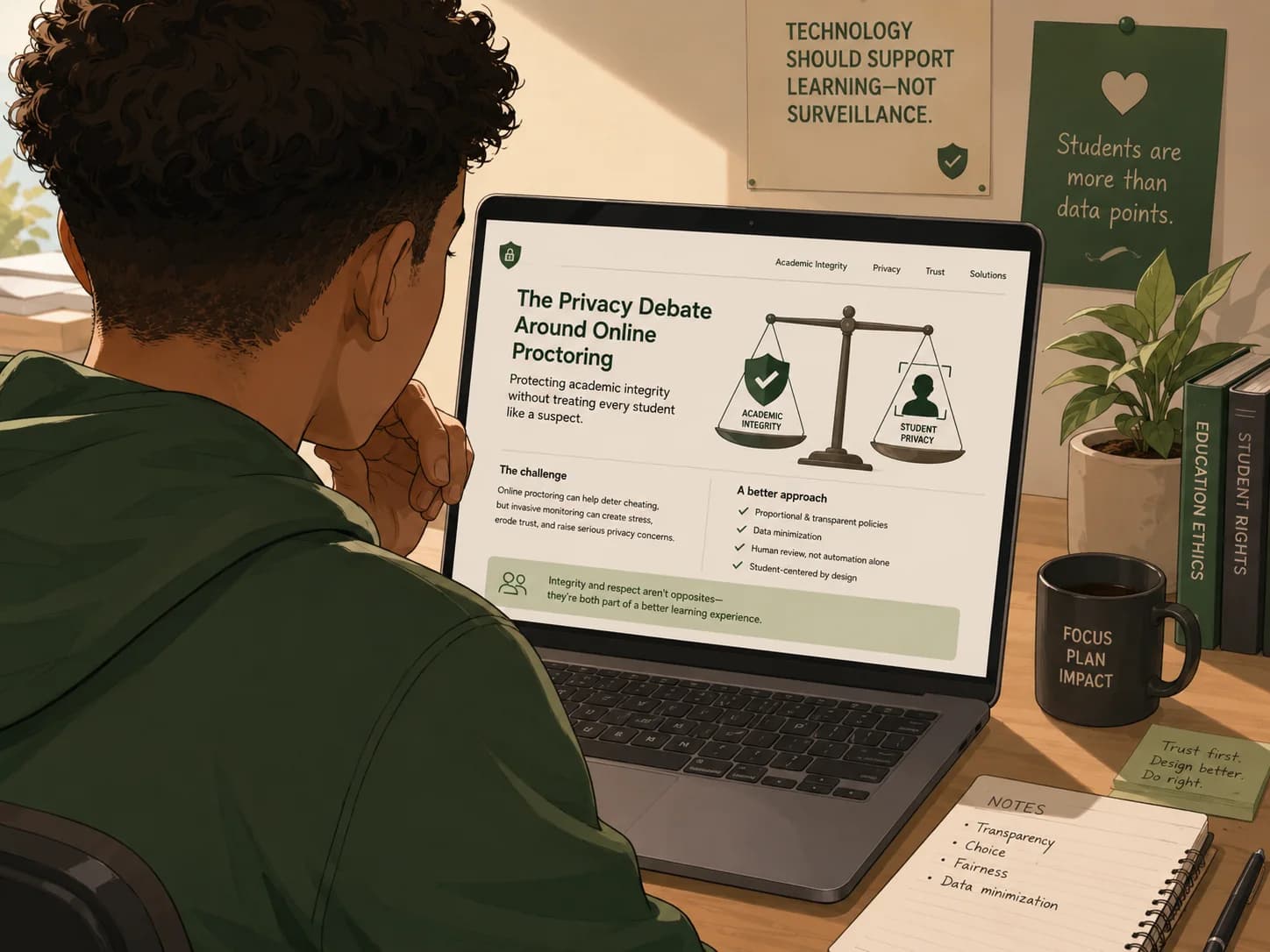
A student’s exam should not feel like a search warrant, and a school’s online test should not feel like an honor system taped to a gradebook.
Teachers turn to proctoring because they need confidence in the grades they assign, while students need those grades to reflect the work they actually did. Those needs fit together: a credible assessment protects students who prepared and gives teachers confidence in the result.
A useful proctoring system should serve a limited purpose, much like a hallway camera. It can discourage misconduct and help explain an incident without trying to document every private moment. The teacher still decides what an unusual event means.
The goal is not to watch everything. It is to make dishonest behavior harder and fair grades more credible.
Match the Controls to the Stakes
A five-question reading quiz does not need the same controls as a certification exam. A routine middle school or high school assessment may need thoughtful questions, a time limit, randomized items, or a short explanation of the student’s reasoning. A professional certification or high-stakes placement exam may justify stronger identity checks and more restrictive monitoring.
Before adding another monitoring feature, ask:
- 1
What is at stake?
Routine quiz, course exam, placement decision, or certification?
- 2
What risk are we addressing?
What specific problem would this feature prevent or help review?
- 3
What is the least invasive option?
Could better questions, time limits, randomized items, or lighter signals address the same risk?
A routine quiz may need better questions and a time limit, while a certification exam may justify identity checks. The controls should follow the consequences.
On a lower-stakes assignment, better assessment design may do more than surveillance. A reading quiz, for example, can ask students to apply an idea to a new passage and explain their answer instead of testing simple recall. Open-book exams, applied case studies, personalized prompts, short written defenses, and oral follow-ups can all make outside help less useful. For a regular exam, secure access, time limits, randomized questions, and browser or tab signals may be enough. Use stronger controls when the consequences justify them, not simply because the platform makes them easy to turn on.
Educators do not all reach the same answer. Research on their experiences shows them weighing privacy concerns against the need for monitoring and considering other kinds of assessment when proctoring is not a good fit.5 In practice, that means designing the work well, explaining the rules, and adding only the monitoring the exam needs.
Privacy Is Part of Fairness
Remote exams take place in bedrooms, kitchens, shared apartments, dorms, libraries, and family homes. A webcam can capture more than the student taking the test. It may show relatives, medication, religious items, financial papers, or the fact that a student does not have a private room at all. A microphone can turn ordinary household noise into a question about whether the student did something wrong.
Students do not all have the same testing setup. A check that is easy for someone with a newer laptop, reliable internet, good lighting, and a quiet room can be difficult for someone sharing a bedroom or using older equipment. Students with disabilities, anxiety, neurodivergence, or unstable connectivity may also be more likely to trigger a system that mistakes friction for misconduct.
Students can support academic integrity while still questioning whether a school is collecting more information than the exam requires. A school that wants students to trust its grades has to explain what it collects, why it needs it, who can see it, and when it will be deleted.
Before collecting student data, explain:
- What is being collected?
- Why is it necessary for this exam?
- Who can access it?
- When will it be deleted?
FERPA may apply when a photo or video is directly related to a student and maintained by a school or a party acting for the school, subject to FERPA’s exclusions. Whether a proctoring record qualifies as an education record remains fact-specific.1
For services used by children under 13, COPPA may apply when a covered online service collects their personal information. In an educational context, a school may consent on a parent’s behalf, but only for a school-authorized purpose and no other commercial use.2
Public institutions also need to take constitutional privacy concerns seriously. In Ogletree v. Cleveland State University, the U.S. District Court for the Northern District of Ohio held that Cleveland State’s virtual room scans were Fourth Amendment searches and unreasonable under the facts of that case. The ruling concerned a public university’s room-scan practice, not online proctoring generally.3Because the answer depends on the school and the data practice, schools should involve counsel when a monitoring policy reaches into a student’s private space. They should be able to explain why the practice is needed, why a less invasive option would not suffice, and how the data will be protected.
Tell Students What Will Happen
Students should know about monitoring before they sit down to take the exam. A syllabus, course policy, and setup flow should explain what permissions are required, whether the session is recorded, what may create a flag, who reviews those flags, how accommodations work, and how long the data is kept. Students should not discover the rules five minutes before the timer starts.
A fair review process
- 01Before the exam: Explain permissions, expectations, and available accommodations.
- 02During the exam: Collect only the signals the assessment actually requires.
- 03After the exam: Review the context and give the student a chance to explain.
Explaining the rules early gives students time to ask questions, request an accommodation, find a suitable testing space, and understand why one exam uses stronger controls than another. It also forces the school to decide which controls it can actually justify instead of quietly turning on every available feature. NJIT’s online proctoring policy offers one example of putting these expectations into course communication.4
Suppose the platform flags a tab switch because the exam briefly froze. The student can explain what happened, and the teacher can look at the timestamp and surrounding signals before dismissing the flag. A family member entering the room or a face-detection alert may have an innocent explanation too.
What Proportionate Proctoring Looks Like
The principle is simple: decide what an exam needs before choosing its monitoring settings. Students should see the permissions required for that session, and the platform should record useful integrity signals without pretending to know what every signal means.
A signal can show
A tab switch, lost screen share, audio activity, or face-detection change occurred.
A signal cannot prove
Why it happened, whether it affected the exam, or whether the student acted dishonestly.
How Proctorly Applies That Principle
Proctorly gives teachers configured integrity signals to review. It provides a token-gated student link that students can use without creating a Proctorly account, but account-free access is not the same as identity verification. Depending on the test settings, Proctorly can record tab switches, fullscreen exits, audio activity, and face-related events. The student flow can also record when screen sharing stops.
A recorded event is a signal, not a conclusion about the student. Proctorly organizes the event, its confidence level, and the available evidence for review. For some flags, Proctorly provides a confidence-based automatic suggestion that teachers can override before recording a confirmed or dismissed decision.
Want to see that approach in practice?
Create a free teacher account to configure a test, review integrity signals, and make the session decision yourself.
The Goal Is a Grade People Can Trust
A routine quiz does not need the controls of a certification exam, just as a certification exam should not rely on a naïve honor system. Match the monitoring to the stakes, explain the rules, and give students a fair way to respond when something unusual happens.
Fair grades should be credible without making students feel as though they are under investigation.
Footnotes & References
- [1]U.S. Department of Education, "FAQs on Photos and Videos under FERPA", Student Privacy Policy Office. ↩
- [2]Federal Trade Commission (FTC), "Complying with COPPA: Frequently Asked Questions", Business Guidance. ↩
- [3]U.S. District Court for the Northern District of Ohio, "Ogletree v. Cleveland State University" Court Decision (PDF). ↩
- [4]New Jersey Institute of Technology (NJIT), "Online Exam Proctoring Policy", Office of the Provost. ↩
- [5]Balash et al., "Educators' Perspectives of Using Online Exam Proctoring", USENIX Security Symposium. ↩